
All About Narcissus
Narcissus finds admirers in all her arrangements and beckons us toward the full expression of Spring!
Named for its association with the mythological figure Narcissus, who fell in love with his reflection, the flower symbolizes self-love and introspection. More commonly today, the bright sunny colors and delightful shapes are symbols of rebirth after winter.
At the Collective, we refer to them as both narcissus and daffodil.
Scroll Ahead to Read About
When Narcissus Bloom
Results from our Vase Life Test
Narcissus Sap Toxicity Testing
Narcissus Shapes Categorization at the Collective
N A R C I S S U S S E A S O N
Narcissus flowers typically bloom from mid-April through late May.
The exact timing depends on the microclimates of the farms where they grow. Along the Front Range, for example, one farm’s crop may be finishing while another’s is just beginning to bloom. This staggered blooming ensures a steady supply of fresh Narcissus flowers throughout the spring season.
Because Narcissus are perennial bulbs, many varieties return each year. You can expect to see familiar types each spring, making it easier to predict availability year over year.

V A S E L I F E
We've read that the vase life of narcissus flowers usually ranges from 4 to 6 days.
To better understand how long these flowers stay fresh, we conducted a vase life test using the Tahiti variety.
We tested 2 bunches of Tahiti that were harvested at "gooseneck" stage, meaning the blooms are pointing outward from the stem at a 90 degree angle, catching them right before the blooms naturally start to open on the plant.
A general rule of thumb with cut flowers is that the longer they're held in the cooler, the shorter the vase life will be when they come out. We were curious to see if this holds true for narcissus.
Bunch A (taller, left) was kept in the cooler for a week, while Bunch B (shorter, right) was kept in the cooler just overnight.
Left Image - Wednesday 3/27, 2nd to Left Image - Thursday 3/28, Right Two Images - Friday 3/29
We started our test on Wednesday and found that by Friday, all the flowers in Bunch A had opened.
By Saturday, all the flowers in Bunch B had opened.
On Monday, after five days, Bunch A started showing the slightest bit of browning at the edges.
Saturday 3/30 and Monday 4/1
Tuesday 4/2 and Wednesday 4/3
The blooms were still holding up well on Tuesday, giving us a solid week of vase life. By Wednesday, the majority of the blooms were finished on both bunches.
There was no obvious difference in vase life between the bunch that had been held in the cooler at a tight stage for a week and the one that only stayed in the cooler overnight.
Narcissus are an easy flower to hold in your cooler and pull out as needed for retail arrangements without affecting vase life.
Understanding Narcissus
S A P T O X I C I T Y
Concerned about mixing narcissus with other flowers?
It is often mentioned that the sap secreted from freshly cut narcissus stems is poisonous to other blooms in an arrangement. Running a test in both 2022 and again in 2025, we've gathered some insights.
In 2022, we conducted a test and found that the sap did not cause an issue as long as the stems were placed in their own water for 24 hours after the initial cutting.
However, we conducted a slightly different test last year and found different results.

2022 Test Results:
We saw no effect on the tulips.
1 - Re-cutting the stems before putting them in the vase.
2 - Re-cutting the stems and replacing the water after an hour.
3 - Re-cutting the stems and changing the water every day.
4 - Not re-cutting the stems.
2025 Test Results:
Less development of other blooms when mixed with narcissus.
On Friday, 4/4, we divided a bunch of anemones and a bunch of tulips, placing each half in a vase.
One half with and one without narcissus to see how the blooms reacted to being in the same water as narcissus.
We gave all the varieties a fresh cut before putting them in the vases and checked back four days later on Tuesday, 4/8.

A (with narcissus) - the other flowers have not opened fully, and the stems haven’t elongated as we're used to seeing tulips and anemones do.
B (without narcissus) - the other flowers are continuing to lengthen, and those anemones are fully open.

Here you can see the stem of the anemone on the left, which was with the narcissus, has not extended, and the bloom has stayed somewhat tighter. The stem on the right has grown longer, and the bloom has fully opened.
Verrry interesting.
O U R C O N C L U S I O N
It's notable that the sap did not actually kill the flowers in the vase, which is usually the concern. But it did seem to keep the tulips and anemones from reaching their full potential.
If being used for events, you should not worry that adding narcissus to an arrangement will cause the other blooms to crash.
As our tests yielded slightly different results this year, we will err on the side of caution and keep narcissus separate from other flowers to allow them ample time to leach out their sap.
If you want to be extra safe, do not re-cut the stems after you receive them.
Slow-release chlorine tablets are also available from companies like Chrysal and are used as a pre-treatment for cut flowers prone to water contamination. We haven't been able to try this ourselves, but we are curious if you have.
Have you had a different experience?
We would love to hear about it!
N A R C I S S U S S H A P E S
The American Daffodil Society has 13 different divisions to organize narcissus!
We try to keep things simple with just 4 main categories:

C L A S S I C
Can be small- or large-cupped, with a white, yellow, orange, or peach cup surrounded by white or yellow petals.

D O U B L E
Multiple layers of white or yellow petals are accented by yellow, orange, or peach in the center.
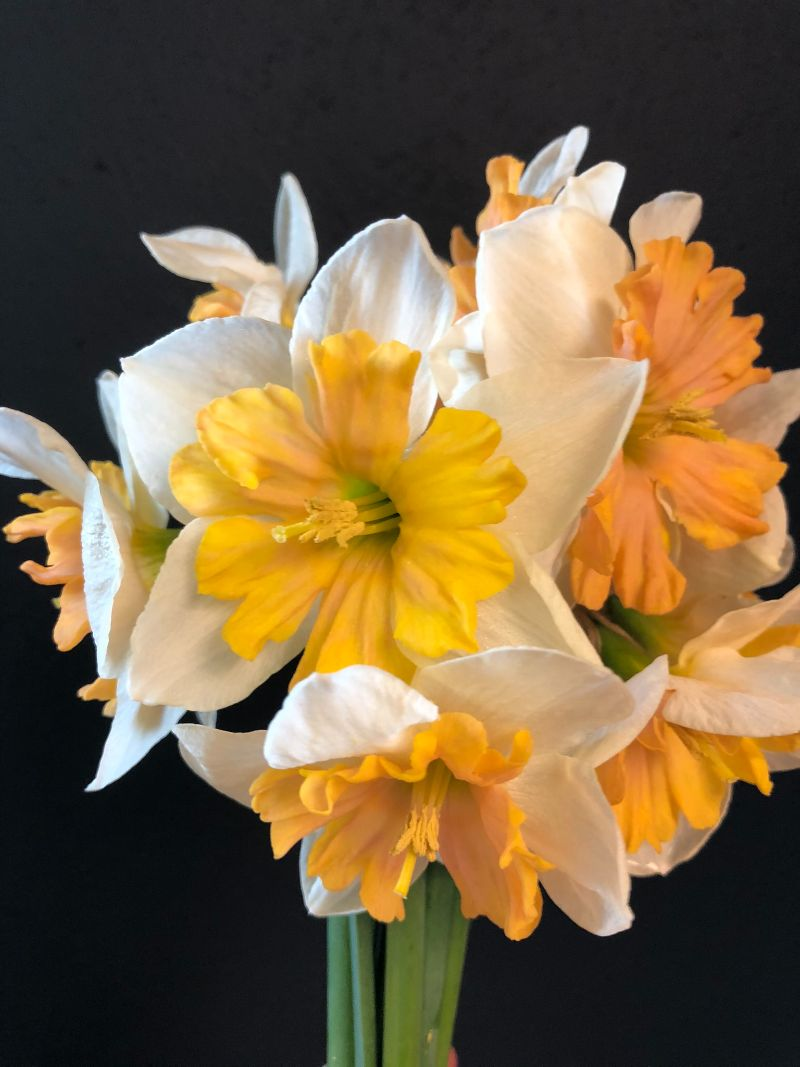
S P L I T C U P
The yellow, orange, or peach center cup lies more flat against a background of white petals, creating a contrasting ruffled center.

S P R A Y
A single stem contains 3-6 miniature white or yellow blooms. The individual small blooms may be the classic single- or double-style.
As with tulips, taking advantage of all the different forms of narcissus allows you to create an arrangement with lots of visual interest, even though you're using one type of flower.

Narcissus season is fleeting so we love when they begin to bloom in early Spring.
All the anticipation and delights of the season are upon us.
Comment or share any experiences you've had with narcissus, and always share your designs by tagging @coloradoflowercollective on Instagram - we love to see them!


Comments